





Cairo, Egypt – 24 December 2025:
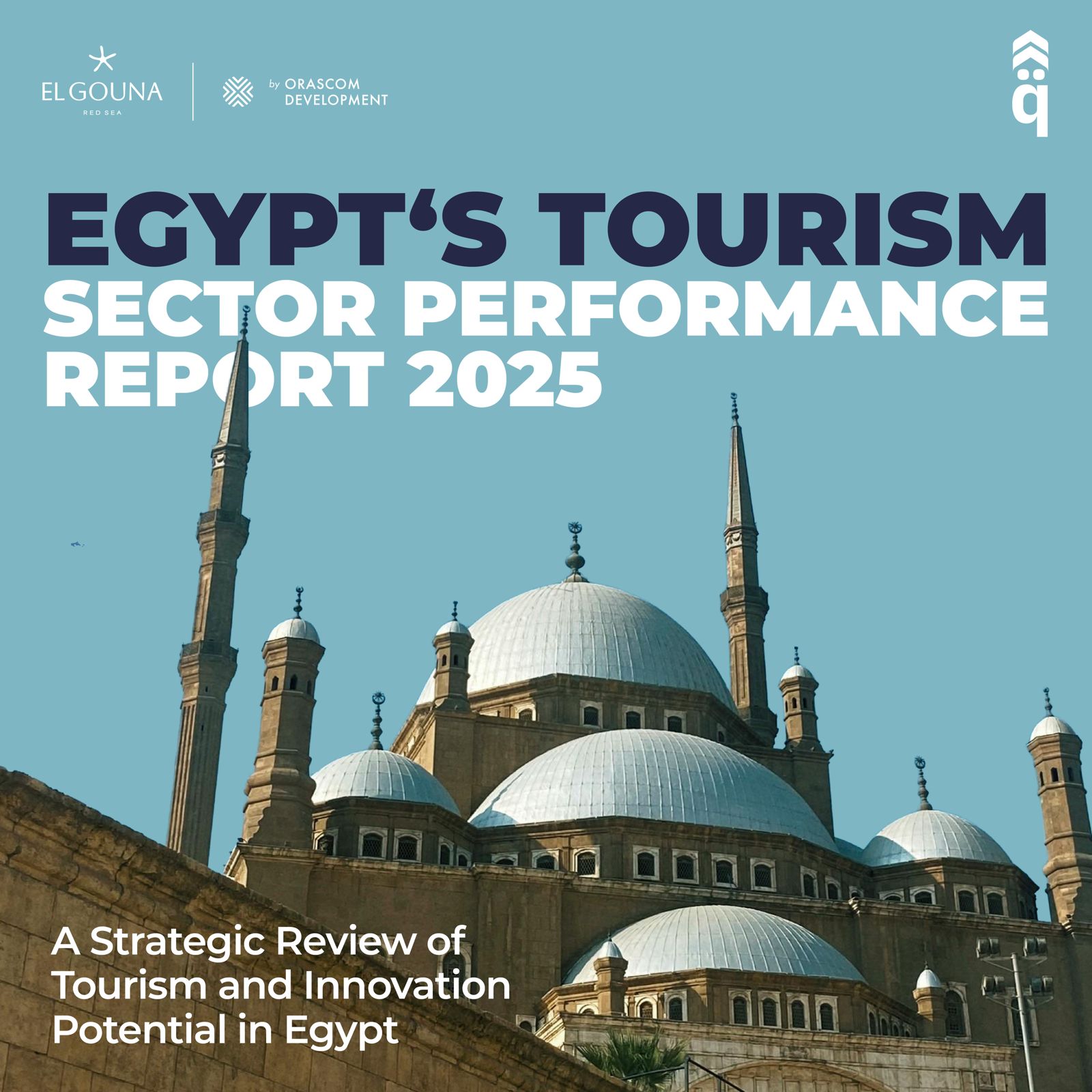
Entlaq, Egypt’s leading policy and research think tank focused on entrepreneurship, innovation, and economic transformation, has officially launched Egypt’s Tourism Sector Performance Report, a comprehensive, data-driven assessment outlining how Egypt can transform its tourism sector through digital reform, TourismTech innovation, and inclusive growth. The report was launched in partnership with El Gouna as Platinum Sponsor, underscoring the destination’s role as a national model for sustainable, technology-enabled tourism development.
The launch comes at a critical moment for Egypt’s tourism sector. In 2024, Egypt received 15.7 million international tourists, the highest annual arrivals in the country’s history. Tourism currently contributes approximately 8.5% of national GDP, generates USD 14–15 billion in annual foreign exchange earnings, and directly and indirectly supports around 2.5 million jobs. Despite this strong rebound, the report finds that value capture per visitor remains below potential, limiting productivity gains and long-term resilience.
Commenting on the findings, Omar Rezk, Co-Founder and Managing Director of Entlaq, said:“Egypt’s tourism sector has proven its global appeal, with record arrivals, a strong post-pandemic recovery, and renewed momentum following the opening of the Grand Egyptian Museum. However, the real challenge today is value creation. Our analysis shows that without coordinated reform across governance, licensing, digital infrastructure, and MSME enablement, tourism growth will remain concentrated and low-productivity. Egypt’s Tourism Sector Performance Report demonstrates that with a unified digital and TourismTech-driven approach, the sector can double its economic contribution by 2030 and shift tourism from a volume-led model to a high-value, innovation-driven engine of inclusive growth.”

Rezk emphasized the strategic implications, adding:
“Tourism MSMEs and startups are not a side issue — they are the backbone of global tourism economies. When these enterprises are locked out by complex regulation, weak financing instruments, and fragmented digital systems, the entire sector underperforms. Unlocking the ‘missing middle’ is not just about inclusion; it is about productivity, resilience, and Egypt’s ability to compete with digitally advanced destinations.”
In this context, Mohamed Amer, CEO of El Gouna, stated:
“We are proud of our partnership with Entlaq on Egypt’s Tourism Sector Performance Report, building on our previous collaboration to host the launch of the third edition of the Egyptian Entrepreneurship Sector Diagnostic Report (SDR 2025). This partnership reflects El Gouna’s role as one of Egypt’s most prominent Red Sea destinations, defined by its identity as a fully functioning, year-round town. Home to more than 25,000 permanent residents from over 50 nationalities, El Gouna sets high standards for hospitality, culture, sports, and experiences through platforms such as the El Gouna Film Festival, G-Space, G-Valley, global sports tournaments, and Taste El Gouna, while positioning the destination as an attractive hub for innovation, entrepreneurship, and TourismTech.”
He added:
“El Gouna’s model contributes to inclusive economic growth by generating stable, year-round employment across hospitality, retail, culture, real estate, education, and healthcare. Through its integrated business ecosystem — spanning the El Gouna Business District, G-Space, and flexible workspace solutions — El Gouna enables startups and creative businesses to operate in a professional yet inspiring environment, reinforcing the role of destinations in supporting entrepreneurship and long-term tourism performance in Egypt.”
The report finds that Egypt’s tourism constraints are no longer rooted in demand or global competitiveness, but in system-level fragmentation. Tourism activity remains geographically concentrated, while large parts of Upper Egypt, the Western Desert, and secondary heritage and eco-tourism destinations remain underdeveloped. Governance responsibilities are split across multiple ministries and agencies, resulting in fragmented licensing, duplicated procedures, and weak coordination between tourism planning, digital transformation, MSME policy, and investment promotion.
According to the report, tourism licensing timelines in Egypt typically range from 6 to 12 months, involve 10 to 16 separate approvals, and remain only 10–30% digitized. In contrast, leading peer markets such as the UAE average 1–2 months for licensing, with 85–95% digital completion, creating a clear competitive disadvantage for Egyptian tourism startups and MSMEs.
- Dr Reham ElMorally, Head of public policy at Entlaq said:
“ A core diagnostic of Egypt’s Tourism Sector Performance Report is the persistence of a “missing middle” gap within the tourism economy. While large-scale projects and established operators continue to attract capital, tourism MSMEs and startups face systemic barriers to scaling. Informality remains particularly high in governorates such as Fayoum, Minya, and Qena, where composite informality scores reach 4.5 out of 5, driven by opaque registration processes, high licensing costs, and inconsistent regulatory definitions.”
“The report identifies TourismTech and digital transformation as the most underutilized growth levers in Egypt’s tourism sector. While Egypt has rolled out digital tools such as e-visas, online ticketing at major antiquities sites, and instant payment systems, these initiatives remain fragmented and disconnected from a unified national tourism data and service infrastructure.”
“Benchmarking included in the report shows that Egypt currently scores zero on several core smart tourism indicators, including national smart destination management systems, integrated digital visitor experience platforms, and structured cross-ministerial tourism data sharing. Peer countries such as Morocco, Indonesia, Kenya, and India have already implemented integrated tourism platforms that support SME onboarding, visitor flow management, and data-driven policymaking, enabling higher average spend and more geographically balanced tourism growth.”
To address these gaps, the report presents an integrated reform agenda spanning digital infrastructure, governance, MSME enablement, and human capital. It highlights that broadband expansion alone can add 1.3–2.0% to GDP for every 10% increase in penetration, while SME digitization programs can raise enterprise revenues by 20–26%. Smart destination management systems could reduce congestion-related revenue losses of 15–20% at major heritage sites.
Scenario-based modeling shows that under a full reform scenario, tourism’s GDP contribution could rise from 8.5% (EGP 1.4 trillion) to 15% by 2030, generating an additional EGP 1.8–2.1 trillion in value added. Annual foreign exchange earnings could increase to USD 25–30 billion, while direct employment could expand from 2.3 million to 3.5–3.7 million jobs, with indirect employment approaching 6 million. Tourism-related fiscal revenues from MSMEs could grow from EGP 5 billion today to EGP 20–25 billion annually, while venture capital inflows into TourismTech could expand four- to fivefold, reaching up to USD 1 billion.
The report concludes that with coordinated reform, Egypt’s tourism sector can evolve from a high-volume recovery model into a high-value, innovation-led engine of inclusive growth and economic resilience in a rapidly transforming global tourism economy.
Report download link : https://entlaq.com/reports/16
In this context, on the other hand, there are many related sector news items that you can follow. For example, we highlight the most important ones in the following list:
- Raya FutureTECH and Raya Auto Launch Egypt’s First EV-Focused Accelerator in Partnership with Entlaq
- Entlaq Announces Pre-Registration for Arqam – Egypt’s First Integrated Data Platform